
How Planar Magnetics Enhance Performance in Advanced Defense and Aerospace Systems

PDF Version

The defense and aerospace systems marketplace is always growing and developing as countries and organizations around the world continue to challenge one another. Companies serving these markets must constantly innovate and, at the board level, planar magnetics are one of the best and most cost-effective ways to address high-frequency circuits with high power density.
The Defense and Aerospace Industry
The expansion in wireless capabilities and power electronics, among other things, has placed a great deal of development pressure on every aspect of society: consumer, industrial, and defense / aerospace. These challenges include the introduction of wide bandgap (WBG) semiconductors and the new circuit topologies resulting from them and other technical advances. This has resulted in electronic circuits that are higher in power density with ever-increasing switching speeds. These issues can be best addressed by using planar magnetics in the design.
According to Data Bridge Market Research (see www.databridgemarketresearch.com), the Global WBG power semiconductor device market is expected to show a market growth as high as 54% through 2028. Major factors behind the growth include WBG’s capacity to endure at high temperature over silicon-based solutions. Another major advantage of WBG materials, especially gallium nitride (GaN), is high-frequency operation, which increases thermal efficiency and reduces component size. To maximize the benefits of WBG, passive and magnetic components required in the circuits should be able to keep up with performance required by the semiconductors.
These advanced semiconductors are demanding the most out of the supporting passives and magnetics on the board. The system efficiency, reliability, and functionality are only as good as the entire circuit. Higher power densities require components that can better manage heat created by operational losses and help move them off the board. Planar devices can more easily attach to heat sinks or other thermal interfaces. Effective and efficient thermal management, especially in defense and aerospace systems, directly impacts reliability, safety, ruggedness, and availability. Their smaller size and flat presentation eliminate many of the design constraints associated with wire-wound transformers.
Advances in driver electronics for motors, microwave and RF, as well as LIDAR and other laser-based systems in defense and aerospace applications are being driven in part by the ability to switch circuits at speeds an order of magnitude faster than before. This has been made possible by the relatively recent availability of advanced wide-bandgap semiconductor materials like Silicon Carbide (SiC) and Gallium Nitride (GaN), which offer significant performance advantages over legacy Silicon. These higher circuit switching speeds place stress on the surrounding passives and magnetics, and planar devices are ideal to address these faster solutions.

Why Use Planar Magnetics?
When it comes to high power densities in power conversion systems, the latest materials and conversion topologies enable the size of magnetic components and passives to decrease in size as the conversion frequency is increased. However, an increase in switching frequency by itself will not necessarily lead to a higher power density. The benefits of high frequency conversion can be manifested by using board-level devices like advanced planar magnetics.
The primary difference between a planar magnetic device and a legacy conventional component is the geometry of the cores and structure of the windings (compare Figures 1 and 2 below). In traditional magnetics the windings are made of wires, and in a planar device the windings are made from pre-tooled parts such as thin copper foils or conductive laminations. This precise positioning of the windings and their geometry make it possible to more easily and accurately predict the electrical specifications of planar transformers and inductors, among other advantages.
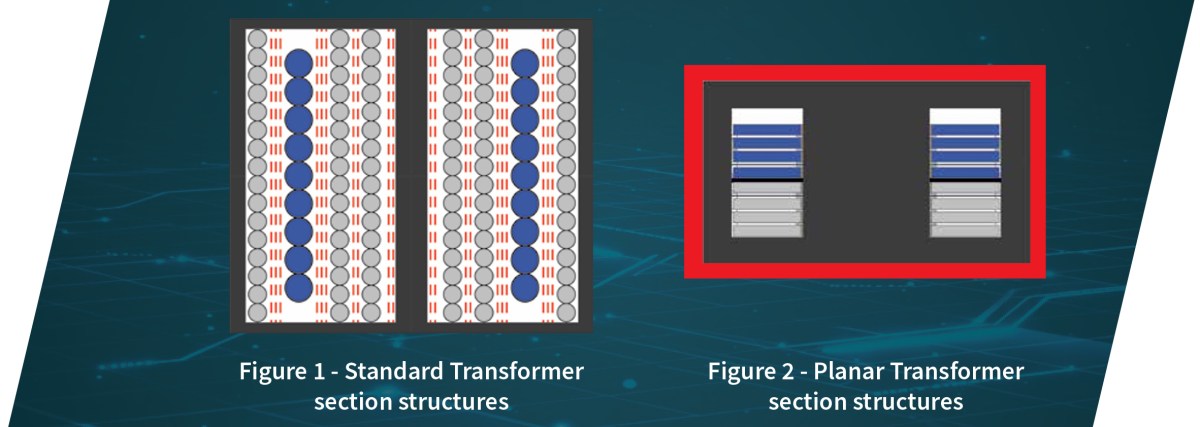
Another major difference is the ratio of ferrite to copper between wire-wound and planar magnetics. A planar device will typically have a core with a larger cross section, but windings with a smaller number of turns. Also, windings on the conventional device are stacked so that they are successively further from the center, where windings on a planar device are stacked. These differences result in a significantly lower profile in planar magnetics. Due to the high degree of consistency in spacing between turns and layers, interwinding capacitance is consistent and winding interleaving reduces AC conduction losses.
When it comes to increasing the converter switching frequency for passive component size reduction, in conventional wirewound magnetic components there is increased loss due to skin and proximity effects in the conductors, particularly at frequencies above 100 kHz. In planar magnetics, the use of flat wide conductors reduces skin and proximity losses in windings in comparison. Planar magnetics also offer improved control of other parasitics such as leakage inductance. The repeatability of component characteristics in planar magnetic devices due to their construction is also an important advantage when designing systems.
Because planar magnetic devices can be implemented in a PCB configuration, interleaved primary and secondary windings can be created more easily than with conventional magnetics. This further reduces leakage and high-frequency winding losses, which offer obvious advantages in high-frequency switching circuits. A further advantage of planar magnetics is the enhanced thermal management capabilities provided by their lower thermal resistance and greater surface area to volume ratio, providing a bigger contact point to the heat sink.

The inherently flat form factor of planar devices lend themselves very well to designing systems with a low profile, often needed in military products. Their flatness also makes packaging and gasketing easier with more uniform surfaces. Planar magnetics also offer a significant size and weight reduction compared to wire-wound magnetics. This is an obvious benefit in aerospace applications, robotics, and other places where every pound counts.
Planar magnetic solutions are also ideal when developing for very demanding and space-constrained applications like satellites. Such areas can be served with a fully custom packaged planar transformer and inductor solution, for example, which results in a significant space reduction compared to individually placed wire-wound transformers.

Planar Magnetic Solutions
There are many solutions available when it comes to planar magnetic devices, for every power level and application vertical. Space-saving planar transformers and power magnetics for defense and aerospace applications not only have mechanical package designs that perform reliably in harsh environments, but they also meet defense specifications, providing high reliability, performance, and safety. Proper selection will ensure the device can cost-effectively handle your application.
For example, there are planar magnetics that can handle power levels in the tens of watts up to devices that can handle thousands of watts, able to carry currents of several hundred amps at frequencies up to the megahertz range. These low profile, high-efficiency devices can serve circuit topologies that include full bridge, half bridge, full bridge ZVS, push-pull, and resonant, among others, with improved performance, reliability, and thermal management capability.
Doing this for military applications means the devices involved need to have terminations that offer high mechanical strength while offering very low electrical resistance, with excellent solderability. Some solutions are available with heatsinks to increase thermal conductivity and remove heat from windings. Large secondary pins can also reduce temperature rise. Custom devices can further address special performance, safety, efficiency, thermal, or reliability concerns.

Development Partners Matter
When it comes to specifying and selecting planar magnetic solutions, a development partner is a vital force-multiplier in a market as complex and competitive as the defense and aerospace community. Selecting an experienced partner that can offer a wide range of space-saving planar transformers and power magnetics for Defense and Aerospace applications greatly eases development pressures. Such a partner should understand the mechanical package design needs to perform reliably in harsh defense environments and be able to withstand thermal and vibration challenges to meet defense specifications with a high level of reliability.
A capable development partner can help you solve the toughest of challenges, with engineers that can work closely with your engineers to understand your needs and select or develop custom quality magnetics. In addition, the partner should understand and be able to help you with supply-chain issues in ensuring you have the right magnetics produced in the right quantities in the right place at the right time.
So, when it comes to addressing defense and aerospace electronic systems and their need for high-power solutions that are also safe, efficient, reliable, and cost-effective, planar magnetics offer a tremendous performance value. Proper device selection coupled with utilizing a good development partner to help you achieve your goals will go a long way towards ensuring a successful design.
Related Articles
-

Powering the Digital Frontier
How Standex Edge enables the Next Generation of Computing with High-Performance Power Magnetics.
-

Dual Active Bridge Transformers
Scaling Dual Active Bridge Transformers for Medium-Voltage Applications.
-

Optimizing Motor Performance
How Custom Standex Edge Magnetics Maximized the Flexibility and Scalability of a Motor Manufacturer’s Motion Solutions.
-

Planar Transformers
How to Select Planar Magnetics for Low Profile, High Reliability Industrial System Designs
-

Smart Grid Thermal Management
How Temperature Managing Magnetics Improve Efficiency, Reliability, and Power Density in Smart Grid Systems