
How Temperature Managing Magnetics Improve Efficiency, Reliability, and Power Density in Smart Grid Systems
PDF Version

Introduction
The modernization of electrical grids is driving unprecedented demand for compact, efficient, and highly reliable power conversion equipment. As utilities integrate renewable energy, battery energy storage, electric vehicle charging infrastructure, and intelligent monitoring systems, power electronics must handle higher current levels while operating in increasingly compact spaces.
These evolving requirements place significant thermal stress on magnetic components such as filter inductors, transformers, and common mode chokes. Excessive heat not only reduces efficiency but also accelerates insulation aging, affects magnetic performance, increases cooling requirements, and ultimately shortens equipment life.
For engineers designing Smart Grid systems, thermal management is no longer simply a cooling challenge—it has become an essential aspect of magnetic component design.
Standex Edge addresses this challenge by combining advanced magnetic materials, optimized winding technologies, and application-specific engineering to reduce losses at the source. Rather than relying solely on external cooling, custom magnetic solutions are designed to improve efficiency, minimize temperature rise, and support long-term reliability across demanding Smart Grid applications.
This white paper explores the sources of thermal losses in magnetic components, discusses engineering strategies for improving thermal performance, and highlights how Standex Edge’s portfolio of Custom High Current Filter Inductors, Planar Power Inductors, Planar Transformers, Common Mode Chokes, and other custom magnetic solutions help engineers build cooler, more efficient Smart Grid systems.
The Growing Thermal Challenge in Smart Grid Systems
Global investments in renewable energy, energy storage, and grid modernization are transforming power conversion technologies. Modern systems require higher switching frequencies, increased power density, and continuous operation under demanding environmental conditions.
Applications such as Battery Energy Storage Systems (BESS), photovoltaic inverters, wind energy converters, EV fast chargers, and Flexible AC Transmission Systems (FACTS) all rely on magnetic components to regulate current, suppress electromagnetic interference (EMI), and maintain power quality.
As current levels increase and system footprints shrink, every watt of electrical loss becomes heat that must be effectively managed. If excessive temperatures are not controlled, magnetic components can experience reduced efficiency, increased cooling requirements, reduced equipment lifespan, lower inductance stability, and accelerated insulation degradation. Consequently, thermal management is no longer an afterthought—it is a key design objective that influences the performance and reliability of the entire power conversion system.

Understanding Heat Generation in Magnetic Components
Magnetic components generate heat through a combination of electrical and magnetic losses. Understanding these mechanisms is fundamental to designing components capable of sustained operation under high-current conditions.
Copper Losses: Copper losses result from the electrical resistance of the winding conductors. As current increases, resistive losses rise according to the I²R relationship, making conductor selection and winding design critical for thermal performance. Standex Edge engineers optimize winding geometry, conductor cross-section, and current distribution to reduce DC resistance and improve efficiency.
Core Losses: Core losses occur as the magnetic material is repeatedly magnetized and demagnetized during converter operation. They consist primarily of hysteresis losses and/or eddy current losses. These losses increase with switching frequency and magnetic flux density, making core material selection an essential aspect of thermal management.
AC Effects: At higher frequencies, skin effect and proximity effect increase AC resistance, resulting in additional heat generation within the winding. Standex Edge addresses these challenges through optimized conductor configurations and custom magnetic designs tailored to each application.
Engineering Thermal Performance Through Magnetic Design
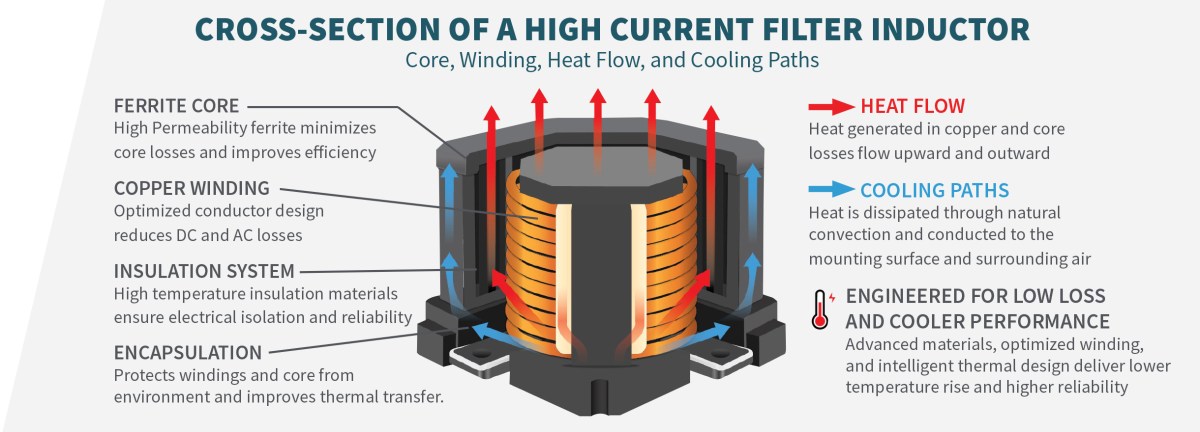
The most effective thermal strategy is to reduce losses before they become heat. Standex Edge approaches magnetic design holistically by evaluating electrical, thermal, and mechanical requirements simultaneously. Key design considerations include selecting low-loss magnetics materials, optimizing winding configurations, reducing DC resistance, minimizing AC losses, managing magnetic flux distribution, and designing for efficient heat transfer.
This integrated approach enables magnetic components to maintain stable electrical performance while operating at lower temperatures.
Standex Edge Magnetic Solutions
Rather than offering a one-size-fits-all approach, Standex Edge develops magnetic components optimized for the specific electrical and thermal requirements of each application.
Custom High Current Filter Inductors: Designed for high-current power conversion systems, these inductors provide low DC resistance, stable inductance, reduced temperature rise, high saturation current, and optimized thermal performance. Typical applications include Battery Energy Storage Systems, renewable energy inverters, industrial converters, and grid-support equipment.
Planar Power Inductors: Planar technology improves heat dissipation through flat conductor geometries that reduce AC losses while supporting compact converter designs. Advantages include improved thermal performance, higher power density, lower winding profile, and consistent manufacturing quality.
Common Mode Chokes: Common Mode Chokes reduce conducted electromagnetic interference while maintaining reliable thermal performance. Applications include EV charging infrastructure, industrial drives, solar power conversion, and grid-connected converters.
Planar Transformers: Planar transformers combine compact construction with efficient thermal characteristics, making them ideal for high-frequency power conversion systems where both power density and cooling are critical. They offer low DC resistance, stable inductance, reduced temperature rise, high saturation current, and optimized thermal performance.
Engineering Magnetic Components That Stay Cool
Thermal management begins long before a magnetic component is manufactured. It starts during the design phase, where every decision—from material selection to winding geometry—affects efficiency, temperature rise, and long-term reliability.
Rather than treating heat as a secondary problem, Standex Edge designs magnetic components to minimize losses at the source. This approach helps reduce cooling requirements while supporting higher power density and longer service life.
Optimized Core Material Selection
The magnetic core is central to the electrical and thermal performance of an inductor. Different materials exhibit different characteristics with respect to core loss, saturation, operating frequency, and temperature stability.
Standex Edge evaluates application-specific operating conditions—including switching frequency, ripple current, current density, and ambient temperature—to identify the most appropriate core material. Key considerations include low hysteresis losses, reduced eddy current losses, long-term material reliability, high saturation flux density, and stable performance over wide temperature ranges.
Selecting the correct core material helps reduce internal heat generation while maintaining consistent inductance under varying load conditions.
Winding Design for Lower Temperature Rise
Copper losses remain one of the primary sources of heat within magnetic components. These losses increase with current and can significantly impact efficiency if conductor design is not optimized.
Standex Edge employs custom winding techniques to reduce both DC and AC resistance. Depending on the application, engineers may incorporate foil windings for high-current applications, parallel conductors to improve current distribution, litz wire for high frequency converters, optimized conductor cross-sections to reduce DCR, and interleaved winding arrangements to minimize leakage inductance.
These techniques help lower operating temperatures while improving electrical performance.
Designing for Efficient Heat Dissipation
Even the most efficient magnetic components generate some heat. Effective thermal management therefore includes designing components that can efficiently transfer heat to the surrounding environment. Standex Edge considers component geometry, mounting orientation, airflow paths, enclosure constraints, and cooling methods (natural convection, forced air, or liquid cooling).
By integrating these factors into the design process, engineers can achieve more uniform temperature distribution and reduce localized hot spots.

Smart Grid Applications
Having reviewed the thermal management principles designed into Standex Edge components, here are how some Smart Grid Applications are improved by integrating these efficiently designed, temperature-managing magnetics:
Battery Energy Storage Systems (BESS)
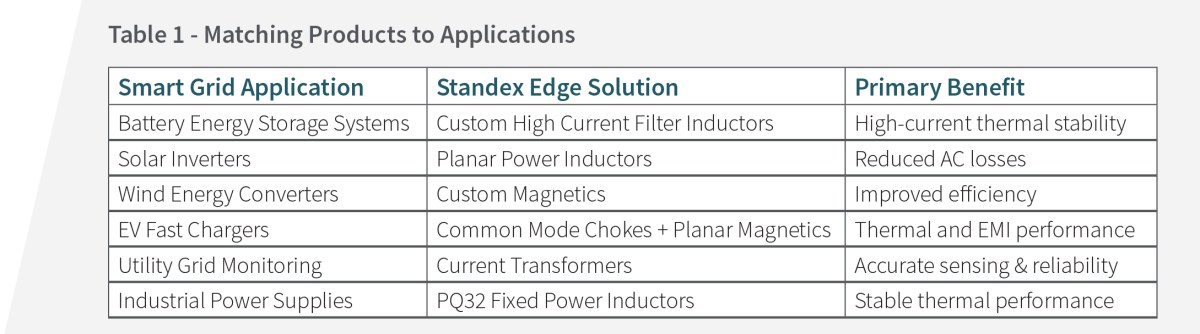
Battery Energy Storage Systems are a cornerstone of modern Smart Grids, enabling energy balancing, peak shaving, and renewable energy integration. Power Conversion Systems (PCS) within BESS operate continuously, requiring magnetic components that can withstand sustained high currents without excessive temperature rise. Standex Edge’s Custom High Current Filter Inductors are engineered to deliver high saturation current, stable inductance, low DC resistance, and efficient thermal performance. These features help improve converter efficiency while supporting long operational life.

Renewable Energy Inverters
Solar and wind energy systems rely on high-frequency power converters to synchronize generated power with the grid. Thermal management is essential to ensure reliable operation under variable load conditions and changing environmental temperatures. Standex Edge’s Planar Power Inductors and Planar Transformers provide reduced AC losses, improved heat dissipation, compact form factors, and high power density. These characteristics support efficient and reliable renewable energy conversion.
EV Charging Infrastructure
High-power EV charging stations require compact power electronics capable of delivering significant current while maintaining thermal stability. Standex Edge solutions — including Common Mode Chokes, Planar Magnetics, and Custom High Current Filter Inductors — help designers reduce electromagnetic interference (EMI), improve thermal performance, increase power density, and enhance system reliability.
Grid Monitoring and Protection
Accurate monitoring of current and voltage is essential for maintaining grid stability and protecting critical infrastructure. Standex Edge Current Transformers provide precise current sensing for protective relays, distribution monitoring, metering equipment, and utility automation systems. Their robust construction and reliable performance support accurate measurements across a wide range of operating conditions.
Industrial Power Conversion
Industrial automation systems, UPS units, and variable frequency drives require magnetic components that can operate continuously under demanding conditions. Standex Edge’s PQ32 Fixed Power Inductors and Custom Magnetic Assemblies are designed to provide consistent inductance, long service life, reliable thermal performance, and compact integration into power electronics systems. Their robust construction and reliable performance support accurate measurements across a wide range of operating conditions.
Conclusion
As Smart Grid technologies continue to evolve, thermal management has become one of the most important considerations in magnetic component design. Higher current levels, increased switching frequencies, and more compact power conversion systems require magnetic components that deliver reliable electrical performance while minimizing heat generation.
Rather than relying solely on external cooling, engineers are increasingly adopting design approaches that reduce losses within the magnetic component itself. Optimized core materials, efficient winding configurations, and application-specific magnetic architectures help improve efficiency, maintain stable electrical performance, and extend equipment life.
Standex Edge supports this approach through a broad portfolio of custom magnetic solutions engineered for demanding Smart Grid applications. From High Current Filter Inductors and Planar Power Inductors to Current Transformers, Common Mode Chokes, and custom magnetic assemblies, each solution is designed to address the unique electrical and thermal requirements of modern power conversion systems.
By integrating magnetic expertise with application-specific engineering, Standex Edge helps OEMs develop power systems that operate more efficiently, remain thermally stable under continuous load, and deliver long-term reliability across renewable energy, battery storage, EV charging, industrial automation, and utility infrastructure.
As the demand for cleaner, smarter, and more resilient electrical grids continues to grow, advanced magnetic technologies will remain fundamental to improving power quality, increasing efficiency, and enabling the next generation of Smart Grid innovation.
Related Articles
-
Leading Edge Smart Grid Magnetics
Designing Power Magnetics Components to Meet Today’s Smart Grid Standards
-
Get the E-D-G-E
…in Custom Defense and Aerospace Magnetics Solutions.
-
Custom, Semi-Custom, or Standard?
Empowering System Designs with Optimal Magnetic Components.
-
Defense & Aerospace Planar Magnetics
How Planar Magnetics Enhance Performance in Advanced Defense and Aerospace Systems