
Empowering System Designs with Optimal Magnetic Components.
PDF Version

Today’s electronic system performance demands require optimum magnetic component solutions, whether they are off-the-shelf, semi-standard, or custom-made for the application.
The latest electronic systems in our products and behind our services are being forced to modernize and migrate into smarter and more functional versions of their previous iterations than ever before. These next-generation electronic products must not only operate in an optimal fashion to address their applications, but they must also do so at the highest levels of efficiency, reliability, and safety. In many cases there must also be a wireless component to address the need for Cloud-based monitoring and management.
These issues are becoming more and more prevalent in today’s device-driven economy. The users, devices, and infrastructure are more integrated than ever, and each has its own application and infrastructure power demands as well as the pertinent regulatory environment. Products and services based on the Internet of Things leverage the wireless ecosystem of the Cloud, and often require their own power methodologies.
These demands for functionality, efficiency, and connectivity mean that the electronic circuits involved must be operating in the most optimal manner that is cost-effectively possible. This also means that the system must integrate the latest core technologies, such as wide-bandgap semiconductors and the latest digital control protocols. The higher switching speeds involved in the latest power designs alone have placed a great deal of pressure on the passives and magnetics to keep up.

The Need for Advanced Circuit Solutions
This demand for enhanced performance is exacerbated by the additional needs of specialty application spaces like Medical, Military, and Industrial, which have very demanding requirements for performance, safety, compliance, and survivability. The power systems involved in these solutions are distinguished by their need for superior noise and EMI performance, operating efficiency, and power density, as well as their ruggedness and environmental resistance.
The issues of noise or disturbances over a very broad frequency spectrum is becoming an increasingly important aspect in modern electrical designs. For example, the complexity of embedded systems is growing at an exponential rate, with an increasing amount of interaction between circuit subsections. If the emitted noise from one circuit interacts with others, there will be unintended results. Medical devices, industrial systems, as well as aerospace and defense vehicles employ an ever-increasing number of components and are capable of emitting and succumbing to electrical and electronic noise.
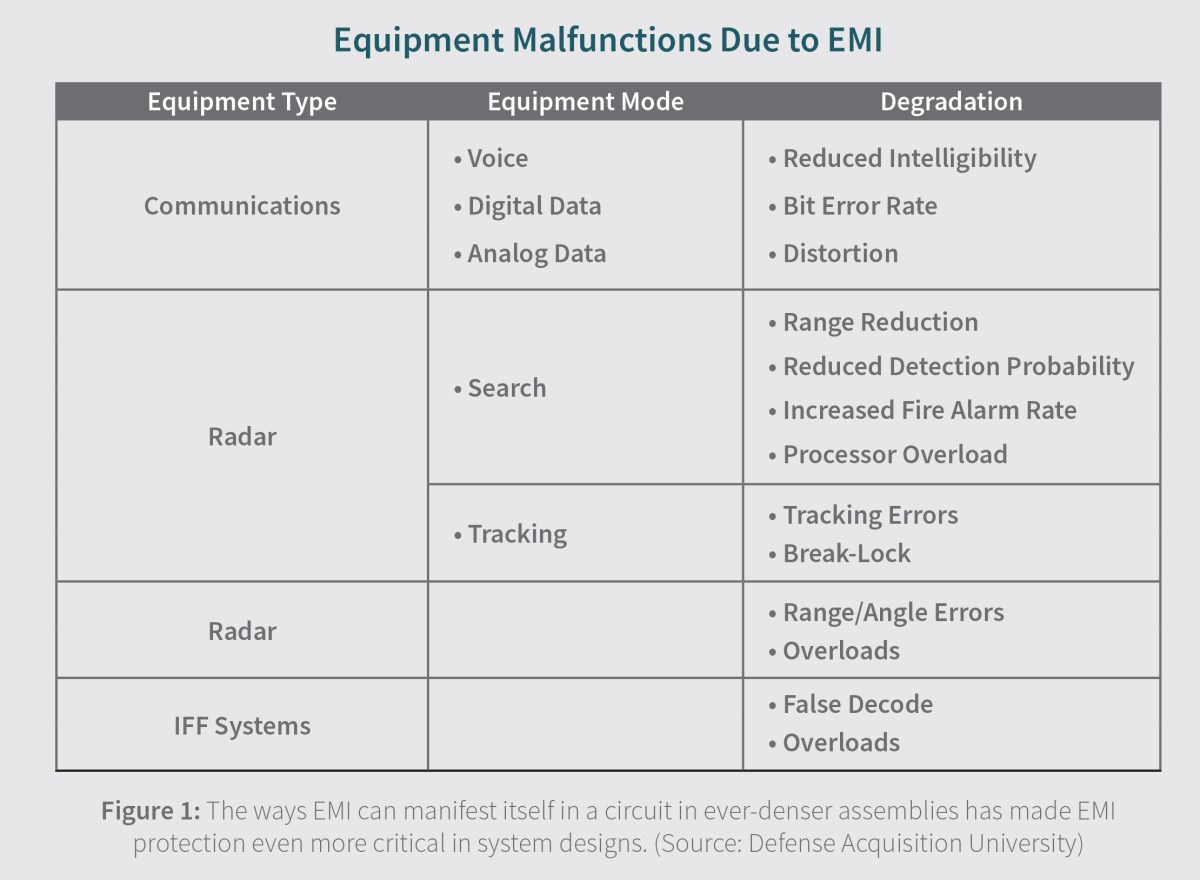
The ways EMI can manifest itself in a circuit in ever-denser assemblies has made EMI protection even more critical in system designs, and factors at all levels of a system must be considered. For example, in military systems there is a range of problems that can be unleashed if EMI is not addressed (See Figure 1 below). At the PCB level, for example, crosstalk and component density play a critical role in EMI emissions, and interference levels are affected by the materials used and the topology of the board, as well as the magnetics used in the circuit.
Broadband EMI consists of artifacts on multiple frequencies, taking up a large portion of the magnetic spectrum. In addition, they exist in different forms and can arise from both natural or man-made sources. Common causes include arcing or corona discharge from power lines, faulty brushes in motors/generators, arcing in ignition systems, bad fluorescent lamps, and even defective power lines. Narrowband EMI comes from a single carrier source, or a tight band of interference frequencies.
Mitigating EMI and radio frequency interference usually involves making sure components don’t emit and aren’t susceptible to electrical noise. For example, integrating a complex communications system on a defense platform must account for every potential RF noise source on or near that platform, and mitigate or suppress them all, not just some. Proper inductor and transformer design can go a long way towards mitigating EMI at the board level.
Optimum Circuits Require Optimum Parts
There are several ways to address performance issues in a circuit, from physical mounting, potting, and insulating from thermal and RF issues, to ensuring the components used are the best for their respective jobs, minimizing EMI and maximizing resistance to it. The transformers, coils, and chokes in a circuit play a large role in efficiency, thermal management, and EMI and RFI resistance.
Starting with component fundamentals at the board level also creates a more stable platform for the entire system, as benefits cascade outwards from every improvement at the device level. Optimized components lead to low or no emissions, mitigating management issues, increase power density, efficiency, and performance, and address thermal and other environmental issues that can cause a loss of reliability and safety.
Creating a custom magnetic solution is the best way to provide this optimized performance, as every aspect of the device in question can be addressed before it is used in the circuit. However, it is important that the customization is cost-effective as well as appropriate to the application. One way to address the cost of a completely custom solution is to modify an existing part, reducing the effort required to create an optimized solution. This is most applicable when the needs of the circuit are only slightly different and can be addressed by minor modifications to an existing part.
Such a semi-custom solution provides a relatively fast and flexible solution that is superior in performance to a standard part but is more cost-efficient than a completely custom part. Using a modified standard part helps address component sourcing and supply-chain issues. Modifying a standard part can distinguish parts for vertical markets or for binning parts according to application-specific functionality. This approach can addresses the need to create solutions serving different regulatory compliance needs, modifying the part just enough to meet different requirements.
A completely custom solution provides an optimum part tailored to the exact performance requirements of the circuit, something a modified part can only partially address, Custom parts also offer maximum flexibility in the desired functionality, while also enabling a scalable, targeted, and configurable solution. A custom part gives you complete control of its desired properties and performance as well.
Partnering for Success
When it comes to the electronics in any given solution, the differing regulatory and safety requirements of the various markets involved are especially challenging to address. International certification compliance is further complicated by industry specifications and special market demands like those in medical or Mil/Aero spaces. Leveraging the expertise and device knowledge of the right development partner can not only help address these myriad demands, but they can also ensure each solution created is done so in a cost-effective manner.
The highly flexible aspect of a custom magnetic component solution shines, as your development partner can adjust the bill of materials to not only address design needs, but supply-chain realities.
The question of whether to “build or buy” is a serious one, and directly impacts every aspect of a product’s development and manufacturing. When it comes to creating custom components,
the primary benefit to you is control. You oversee the complete process, providing far more flexibility than solutions limited by standard line-card products. While standard products, especially from an experienced vendor, can address most system needs, there are application spaces and marketplaces that need special attention. These are served best by customized, optimized devices.
Looking Forward
In today’s disruptive and competitive electronics marketplace, the importance of an optimal electronics solution in your products is critical. Problems stemming from poor component selection like poor battery life, inadequate thermal performance, or difficulty meeting regulatory requirements can mean the difference between success or failure. The right custom solutions development partner can remove a great deal of the difficulty of going it alone in today’s environment.
Especially when it comes to challenging application spaces, the best vendors have an overview of the complete continuum of environmental requirements and can help you develop electronics solutions designed to meet the needs of specific platforms and application conditions. Custom devices, unlike commercially
available products, are designed from the ground up to address the unique needs of the application in question to leverage and integrate the latest technologies and solutions.
Related Articles
-
Optimizing Motor Performance
How Custom Standex Edge Magnetics Maximized the Flexibility and Scalability of a Motor Manufacturer’s Motion Solutions.
-

Planar Transformers
How to Select Planar Magnetics for Low Profile, High Reliability Industrial System Designs
-

Smart Grid Thermal Management
How Temperature Managing Magnetics Improve Efficiency, Reliability, and Power Density in Smart Grid Systems
-

Leading Edge Smart Grid Magnetics
Designing Power Magnetics Components to Meet Today’s Smart Grid Standards
-

Get the E-D-G-E
…in Custom Defense and Aerospace Magnetics Solutions.